
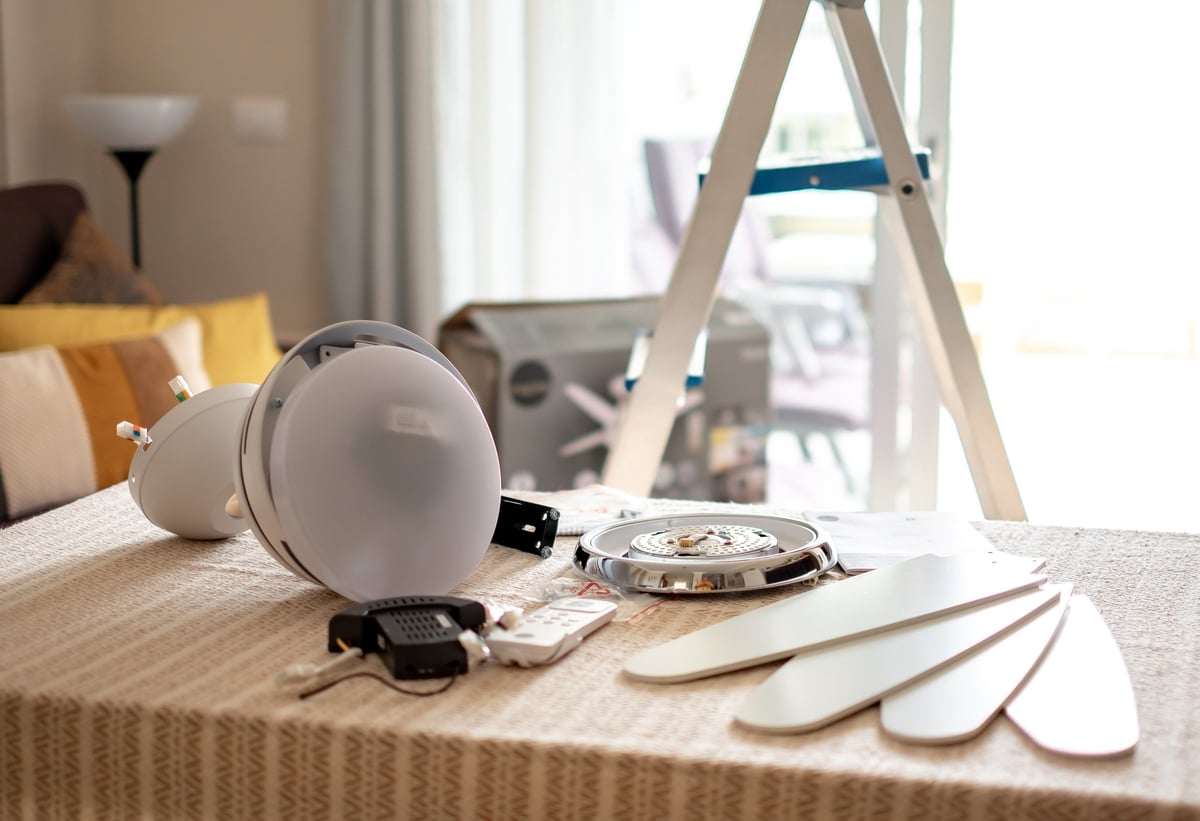
Ceiling Fan Replacementacross Central Ohio
Replacing a dated, noisy, or failing fan at an existing location — the job we do most often, and usually the simplest one. We verify the existing support before the new fan goes up.
What's Included
Out with the old, verified support for the new
A replacement is the most straightforward version of this work, because the location already has a fan. The wiring is there, the box is there, and the ceiling has already carried this kind of load.
We still check the support rather than assuming it. A box that held a lightweight fan for twenty years may not be rated for a heavier replacement, and it costs nothing to look.
- Removal of your existing fan
- Checking that the existing mounting support suits the new fan
- Installation of the replacement fan and any integrated light
- Downrod sizing if you are switching mount style or the ceiling calls for it
- Verification that the fan and light work together correctly
- Cleanup of the work area when finished
Deciding
Replace or repair?
Not every problem needs a new fan. Here is how we think about it.
Usually worth repairing
- A wobble caused by unbalanced blades
- A loose mounting that just needs tightening
- A remote that needs re-pairing or a new battery
- A pull chain that has come loose
Usually worth replacing
- Worn bearings — a grinding or humming that keeps worsening
- Sagging or warped blades
- A failed integrated light kit on an older fan
- A fan over fifteen to twenty years old with several problems at once
- A ceiling box that flexes — though the support must be fixed either way
Replacement Questions
Ceiling fan questions from Replacement homeowners
When should I replace a ceiling fan rather than repair it?
Replacement usually makes more sense than repair once a fan is worn — typically after ten to twenty years, or sooner for builder-grade units. Worn bearings, sagging blades, a failed light kit, and persistent wobble are all signs the fan is at the end of its life rather than in need of a small fix. If the fan is simply unbalanced, that can often be corrected without replacing anything.
Can you replace my fan with one I bought myself?
Yes. A replacement is simply a removal and an installation, so the same customer-supplied arrangement applies — you buy the fan, we remove the old one and mount the new one. Send us the model and we can confirm it suits the location.
Do you remove and dispose of the old fan?
The old fan is removed as part of the replacement. Ask us about disposal when you request your estimate and we will tell you what we can do for your specific job.
Will the new fan fit where the old one was?
Usually, but not automatically. Two things matter: whether the existing ceiling box is rated for a fan (it usually is if a fan was already hanging there, but we verify rather than assume), and whether the new fan's mounting type suits the ceiling. A flush mount and a downrod fan mount differently, so if you are switching styles, tell us.
My fan wobbles — does it need replacing?
Not necessarily. Wobble usually comes from unbalanced blades, a loose mounting, or a ceiling box that flexes because it was never rated for a fan. The first two are often correctable. The third is a support problem that has to be fixed regardless of which fan hangs there. We diagnose before recommending replacement.
Time for a new fan?
Tell us what you have now and what you are considering. We will tell you what the replacement involves.